Four Years of Work, No One to Do It: The Paradox of Korea's Shipbuilding Supercycle
A contract was signed in Washington, D.C. on July 23. On one side was HD Korea Shipbuilding & Offshore Engineering, on the other the software arm of Germany's Siemens. Korean shipbuilders sign contracts abroad all the time, but this counterparty was neither a shipowner nor an equipment maker. It was a software company, and this was a full contract rather than a memorandum of understanding.
Following the reasoning behind why a shipbuilder posting record earnings is spending money on software shows where the industry currently stands.
By the Numbers It Is a Perfect Boom
Start with this year's results for the big three. Combined first-quarter operating profit at HD KSOE, Samsung Heavy Industries and Hanwha Ocean was in the two trillion won range. The second-quarter consensus was more than 15 trillion won in combined revenue and about 2.3 trillion won in operating profit. At that pace annual combined operating profit passes 9 trillion won, and some analysts talk about crossing 10 trillion. The three companies hold an order backlog of roughly 190 trillion won ($137 billion), and forecasts see it passing 200 trillion won again within the year.
Compared with a decade ago the figures are hard to believe. Korean shipbuilding in the mid-2010s went through trillion-won losses, voluntary redundancies and dock closures. The companies that survived that restructuring now hold three to four years of work and can pick and choose high-value vessels such as LNG carriers. This is a market where refusing to build cheap ships actually works.
Inside the industry, though, the tone is different. One phrase has been circulating since the start of the year: a sandcastle boom.
The Docks Are Full, the Coveralls Are Not
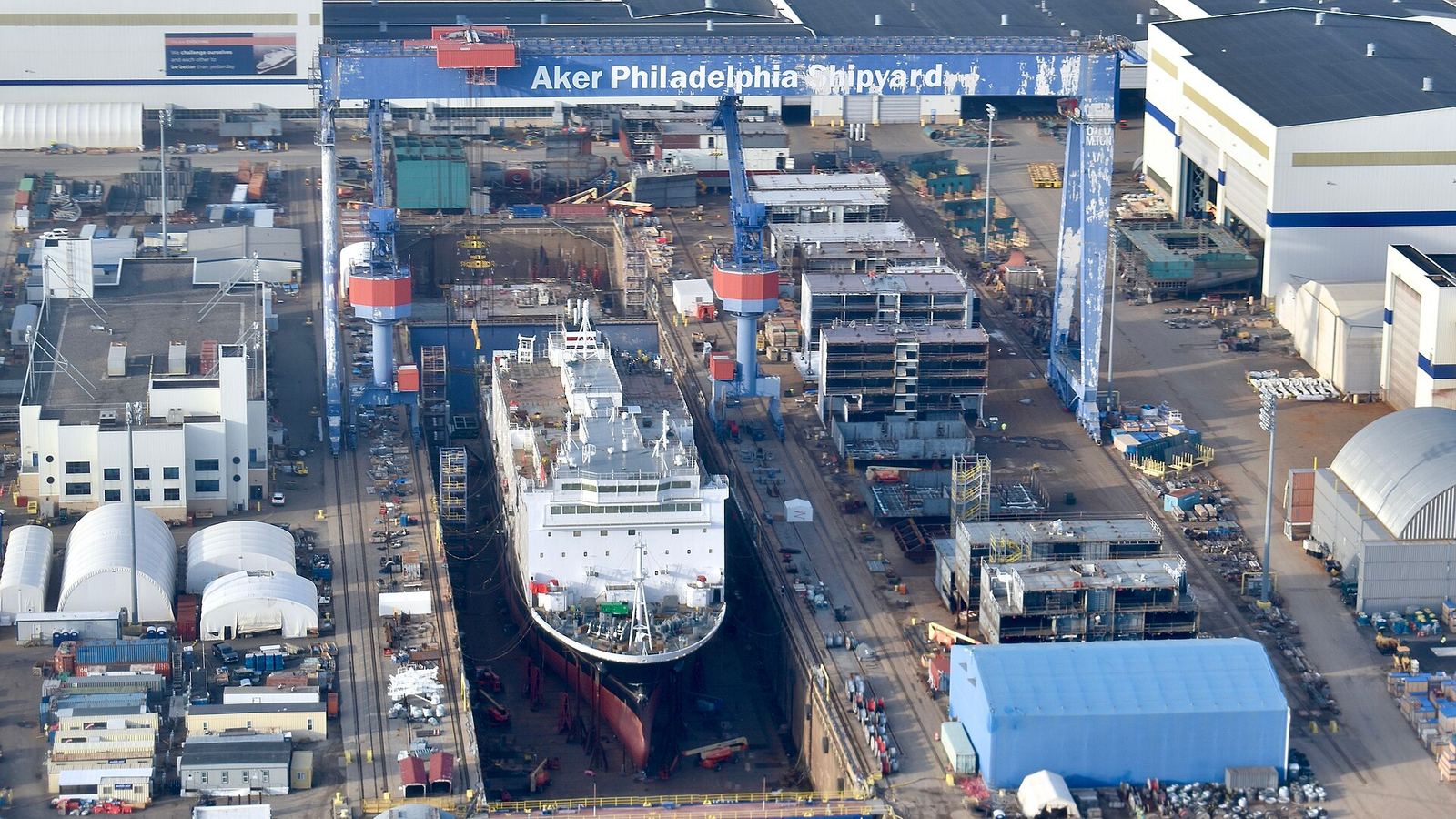
An order backlog of 190 trillion won means that many ships actually have to be built over the next few years. The problem is finding people to weld and assemble them. Hull and welding trades are physically demanding and largely outdoors, and the younger generation that watched overtime disappear and unit rates get cut during the last downturn has not come back. Balance sheets returned to profit, but the perception that a shipyard is a hard place to work has not changed at the same speed.
So the question separating shipbuilders now is not the value of orders. It is whether the ships already sold can be built on time and at cost. Late delivery brings liquidated damages, and schedule slippage lowers dock turnover. Those losses eat directly into today's headline profits. A backlog is an asset only when execution capacity backs it up.
Three Companies, One Direction
Line up what the big three have done recently and the direction converges. Rather than filling the missing headcount, they are changing how the yard works.
The contract mentioned at the outset, HD KSOE's full contract with Siemens for a next-generation marine platform, is the clearest example. It consolidates data across design, production, supply chain, quality and maintenance into a single data set built on 3D models, with the aim of reducing schedule delays and quality problems. Detailed development starts this year, rollout at major domestic sites begins in 2028, and the roadmap extends to a "physical AI" yard where robots and autonomous production equipment judge work conditions on their own.
Samsung Heavy Industries is automating the pipe process from cutting through welding with AI. The order is to mechanize first the processes that take the most manual work and where workers are hardest to find. Hanwha Ocean has ordered shipbuilding robots to automate welding while widening its business into defense vessels, including a Thai next-generation frigate program worth about 800 billion won and submarine exports.
Owners Are Choosing Yards on Different Criteria
This is not simply a Korean fashion. Evaluation criteria among shipowners are shifting in the global market. Dock size and build record used to be the measure; recently the ability to integrate design, production, logistics and quality data and to forecast schedules and resource allocation, so-called smart yard capability, has become a variable in winning orders. "Automated yards decide who wins the order" now appears as a headline in trade coverage.
From the owner's side it makes sense. With every yard booked for years, what an owner wants confirmed is the delivery date. No yard can reassure anyone with an empty dock, so the yard that can prove its delivery date with process data gets chosen.
What Has to Be in Place Before the Robots
One premise underlies this picture and is easy to miss. Robotic welding and AI schedule forecasting both work only when design, production and quality data flow as one body.
Conditions on the ground are still far from that. Design data sits in one place, production results in another, subcontractor man-hours in spreadsheets, quality records in yet another system. No AI laid on top of that produces a usable forecast. Reading "single data" as the first keyword in the HD KSOE and Siemens contract suggests the same diagnosis.
Making data into one body is closer to groundwork than to advanced technology. Building a code structure that runs through project, block, process and trade; arranging man-hours, schedule and cost so they aggregate on the same basis; getting site results into the system on time. Supporting shipbuilding and heavy industry sites, what we have seen repeatedly is that digital transformation succeeds or fails in this tedious stretch.
The supercycle will end at some point. If the last cycle taught anything, it is that where the profits of the boom were invested decided who survived the next winter. This time that investment is going into data and software rather than more docks. If there is a counterargument to the word "sandcastle," it will probably come from there.
DT Solution has built man-hour management, schedule management (EVMS) and document management systems at shipbuilding and heavy industry sites. Drawing on data integration verified in projects at major shipbuilders including Samsung Heavy Industries, we help design the groundwork for a smart yard transition. Contact us to discuss your project.
- Newspim, Shipbuilding Big Three Approach 10tn Won Profit and 200tn Won Backlog (Jul 2026)
- Newspim, From Design to Sea Trial in One: HD KSOE Builds an AI Shipyard (Jul 2026)
- Maeil Ilbo, Automated Yards Decide the Order: Global Shipbuilding's AI Race
- Herald Business, Record Supercycle but No Workers: Concerns Over a Sandcastle Boom (Feb 2026)
- Newsway, Shipbuilding Big Three Target AI and Defense as Next Growth (Jul 2026)