AI Agents in Korean Construction and Shipbuilding: Where They Are Actually Used
Between late 2025 and 2026, the AI agent cases disclosed by major Korean construction and shipbuilding firms fall into two application areas. Construction firms handed over document work first, including bid proposals, contracts and daily work reports, while shipbuilders applied agents to production processes such as welding and block assembly and are at the same time working out how to record what skilled workers know. What follows is a summary of what each company has disclosed and the figures that could be confirmed.
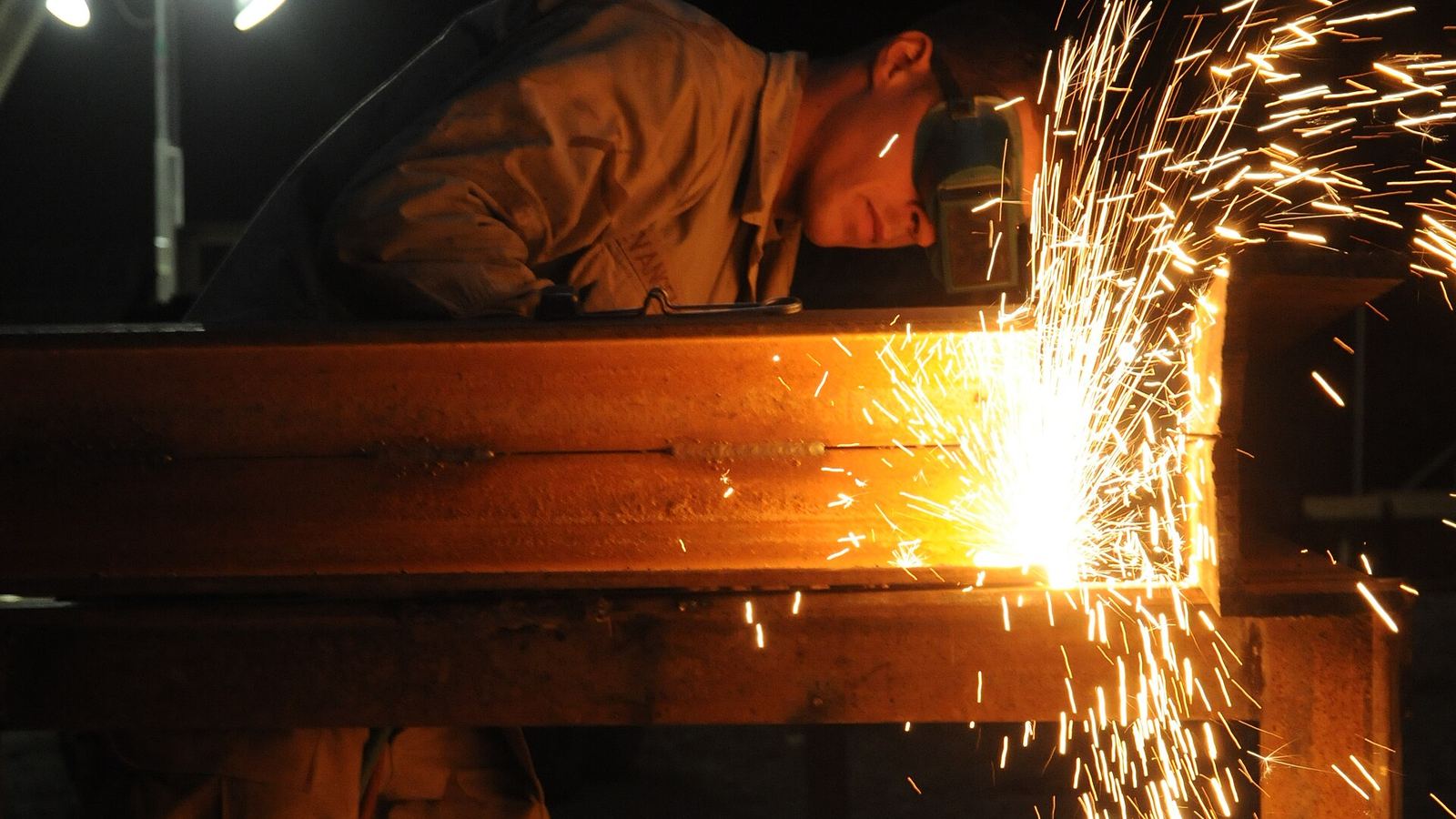
Flat-block assembly at HD Hyundai Heavy Industries' Ulsan panel shop No. 2 once required seven skilled workers, but one employee now runs several collaborative robots that locate weld seams through AI vision. Daily output rose from 500 tons to 750 tons on the day shift, and the company says running both shifts can push it to 1,000 tons.
Labor and management at the same company set up a joint council on February 10, 2026 to deal with automation and robot adoption, yet after five meetings the discussion is still at the stage of setting a direction. One union member told a local newspaper in Ulsan that "the industrial transition and the technology are already decided, and the union is only asked to clean up afterward." HD Hyundai has installed 82 robots since June 2024.
Starting With Contracts Thousands of Pages Long
Construction firms applied AI agents to office work before the field. On November 11, 2025, at its headquarters in Gangdong-gu, Seoul, Samsung C&T presented three agents co-developed with AWS to an audience of about 400 employees and AWS Korea staff. AI-ITB Reviewer analyzes bid proposals and flags risk clauses, AI-Contract Manager supports legal and contract review, and AIPEX consolidates and analyzes project data scattered across sites. The roadmap the company stated is to apply them to every construction project from 2026 and to move all work onto an AI basis by 2028. CEO Oh Se-chul said AI matters more as projects grow larger and more complex, and EVP So Byung-shik said the company will judge AI's value only by the problems it actually solves.
Daewoo E&C also applied a document analysis AI to overseas bid and contract review and says it verified review speed on the Czech nuclear power project. Overseas EPC bid documents run to thousands of pages, and penalty clauses or the scope of liability for schedule delay are scattered throughout.
Contract documents came first because the records exist. Bid proposals and contracts have accumulated in the same format for decades, with review history and the basis for decisions written into the documents. Adjustments and agreements made in the field, by contrast, mostly leave no record.
90 Minutes a Day, 375 Hours a Year
There are also in-house cases with numbers attached. POSCO E&C ran a company-wide AI contest from March 24 to May 15, 2026. Roughly 2,000 people took part, close to half the workforce, and 1,887 entries were submitted. The top entry in the AI agent category was a daily work report automation agent. It cuts repetitive work that took site staff more than 90 minutes a day, which the company calculates as 375 hours per person a year, about two months of work. A company official said the biggest result was that employees began to see AI as a colleague that changes their own work.
GS E&C was the first construction firm to adopt ChatGPT Enterprise, and it reorganized its internal contest, "AX Recipe," from individual entries to teams from operating units. About 50 real usage cases were shared, centered on document automation and data analysis. An executive workshop in March drew about 110 people including CEO Huh Yoon-hong, and the best entries will be selected in September for review toward actual deployment.
Hyundai E&C built an internal AI assistant instead of using external generative AI directly. It is based on ChatGPT, Claude and DeepL, with access limited to internal systems and the H-PASS app, and is used mainly for work that requires finding exact source documents, such as technical standards or legal review. SK Ecoplant's reorganization raised its AI solutions unit to the same level as the building, civil and plant units and created an AI innovation officer reporting to the president. DL E&C said it will widen the scope to schedule and cost management and to early detection of safety risks.
What Shipbuilders Are Working On
The problem shipbuilders face differs from construction. Kim Young-ok, HD Hyundai's group chief AI development officer, presented the shipbuilding AI master agent concept at KDD 2026 in Jeju and said: "The most valuable asset we have is the judgment of a welding expert with 30 years of experience, yet that knowledge has never been properly documented."
The concept has three layers, with HD Agent handling general-purpose services at the bottom and, above it, a ship design agent that handles contracts and optimization and a ship production agent that covers block management, equipment automation and multilingual communication with workers. The master agent at the top integrates design, production, safety, quality and multilingual operations. For this structure to work, the tacit knowledge of skilled workers has to be converted into ontologies first, and that work is still in progress.
Hanwha Ocean and Samsung Heavy Industries put equipment and data in place first. At Hanwha Ocean's Geoje yard one worker operates three welding robots, roughly tripling productivity, and the company has a plan to invest 300 billion won by 2030 to raise the indoor welding automation rate from 67% to 100%. Samsung Heavy Industries runs SYARD, which consolidates data from quotation through delivery, and on October 29, 2025 in Geoje it unveiled S-EDP (SHI-Engineering Data Platform), a design automation platform, saying it will more than double the design automation rate by 2030. CEO Choi Sung-an described S-EDP as the foundation of a smart shipyard combining DX, AX and RX.
| Company | What was applied | Confirmed figures |
|---|---|---|
| Samsung C&T | AI-ITB Reviewer, AI-Contract Manager, AIPEX (with AWS) | All projects from 2026, all work AI-based by 2028 |
| POSCO E&C | Daily work report automation agent and other in-house entries | 1,887 entries, est. 375 hours saved per person a year |
| GS E&C | ChatGPT Enterprise, AX Recipe team projects | About 50 usage cases, winners chosen in September |
| Hyundai E&C | Internal AI assistant | Technical standards and legal review, internal network only |
| Daewoo E&C | Document analysis AI | Verified on Czech nuclear bid and contract review |
| HD Hyundai | Shipbuilding AI master agent concept, collaborative robots | 82 robots since June 2024, flat block 500 to 750 tons |
| Hanwha Ocean | Welding robots, smart yard | 3 robots per worker, 300 billion won by 2030 |
| Samsung Heavy Industries | SYARD, S-EDP | Design automation rate to double by 2030 |
The Firms That Collect No Data
All of the above concerns top-tier firms. In the 2024 SME informatization survey by the Korea Technology and Information Promotion Agency for SMEs, covering a sample of 456 companies, 80.3% of construction firms with revenue above 500 million won answered that they do not even collect data. Adding those that collect but do not use it, nine out of ten construction firms make no practical use of AI. One tally also finds that more than half of the 44 AI adoption cases at the top 10 construction firms are concentrated in the past two years.
R&D spending as a share of revenue is 1.61% at Samsung C&T, 1.09% at Hyundai E&C and 1.04% at Daewoo E&C. When the Korea Institute of Civil Engineering and Building Technology surveyed 107 industry workers, the obstacles cited were, in order, securing data and its quality, a shortage of AI specialists, and the absence of base technology specific to construction.
The work where agents have been applied so far is concentrated in tasks with a fixed format that leave records: bid proposals, contracts, daily work reports, weld positions. Judgments summarized verbally in meetings, or the history of on-site adjustments that only one person remembers, have no application cases yet. That is also why HD Hyundai started by converting a 30-year welder's judgment into ontologies. The question each company has to answer next is how much of what they currently do not record they are going to record. As the labor-management council that could not set a direction in five meetings shows, that decision is hard for a technology unit to make alone.
Samsung C&T Newsroom, "Samsung C&T Presents AI Native Construction Roadmap," November 2025. news.samsungcnt.com
Money Today, "Samsung C&T to Become an AI Construction Company, Roadmap With AWS," November 12, 2025. mt.co.kr
Newswatch, "Samsung, GS, POSCO, Daewoo, SK: The Shift to AI-Centered Construction Firms." newswatch.kr
Herald Business, "375 Hours Saved a Year: POSCO E&C's Company-Wide AI Contest," May 18, 2026. biz.heraldcorp.com
Edaily, "GS E&C Accelerates Company-Wide AI Internalization With Field-Led AI Agents." edaily.co.kr
Hyundai E&C Newsroom, "AI Tools Applied Directly to Practice." hdec.kr
IT Daily, "HD Hyundai's Shipbuilding Master Agent Concept." itdaily.kr
Asia Today, "Robots Weld, AI Judges: Inside HD Hyundai's AI Shipyard," June 14, 2026. asiatoday.co.kr
Ulsan Maeil, "HD Hyundai Heavy Industries' Labor-Management Council on AI and Robots Stalls." iusm.co.kr
Metro Seoul, "Shipyard Automation Moves From Future Investment to Earnings Variable," May 10, 2026. metroseoul.co.kr
SME Daily, "Samsung Heavy Industries Unveils S-EDP, Targeting Double Design Automation by 2030," October 29, 2025. smedaily.co.kr
Opinion News, "AI Adoption Limited to Large Firms: The Widening Technology Gap in Construction" (citing the 2024 SME informatization survey and a KICT survey). opinionnews.co.kr